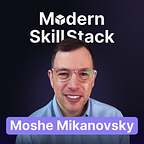
Modern Skill Stack — real stories on how product professionals keep up with a constantly changing skills landscape. Hosted by Gene Kamenez, CEO of Uxcel.
Watch on YouTube.
Most conversations about AI and product management jump straight to the scary part: who gets automated away. Moshe Mikanovsky’s answer is more useful, and a little uncomfortable. AI isn’t going to replace product managers. It’s going to make it obvious which ones were never really doing the job.
I wanted Moshe on the show because he’s seen the role from almost every angle. He spent 35 years across engineering and product, built 23 digital products across nine sectors, coached more than a hundred startups, and taught at the Schulich School of Business at York University in Toronto. At Uxcel he created the Business & Technical Fundamentals for PMs course and the Product Vision & Strategy course. He also co-hosts the Product for Product podcast and runs Products for Good, a consultancy that helps founders avoid expensive product mistakes.
So when he talks about what separates a real product manager from someone just moving tickets around, it’s worth slowing down to listen.
This episode is brought to you by Uxcel.
Uxcel is a learning platform used by 500,000+ product professionals and 200+ organizations to build cross-functional skills across UX design, product management, and AI. Learn through short, gamified courses that fit into a working day, earn certifications, and build a portfolio with real-world project briefs.
Start learning at uxcel.com.
You’ll learn:
Why “cross-functional” doesn’t mean everyone owns everything — and the ownership lines that keep a triad healthy
The moment Moshe’s engineering instincts backfired in his first PM role, and what it taught him about trust
Where PMs most often misread the situation (it’s almost always the business side, not the technical one)
A simple test for finding your real skill gap: follow the discomfort
How AI is splitting PMs into two groups, and which one is safe
The parts of the job Moshe is convinced AI won’t touch any time soon
My biggest takeaways
Cross-functional doesn’t mean everyone owns everything
The PM role touches business, engineering, design, and often marketing. It’s easy to read that as “the PM is responsible for all of it.” Moshe pushes back on that. The job is cross-functional, but ownership still has to live somewhere.
In Moshe’s words:
“If you have the right triad, you have product managers, designers, and engineers, then there should be a responsibility and ownership for each one of them. Because if you expect everyone to do everything, then what’s the point of having their expertise?”
His split: product owns value and viability (the business and strategic side), design owns usability, engineering owns feasibility. The lines aren’t walls — you still feed off each other and trade ideas — but someone has to be accountable for each piece. Shared everything usually means owned by no one.
An engineering background is a gift and a trap
Moshe came into product from engineering, and at first that felt like an edge. Then it tripped him.
“I would not just write stories and solutions to build, but I also wrote in the stories, you should have this table in the database... the first time the engineers saw that, it was like, what is going on here? This is not what you’re here for. So that was a very quick wake up call for me.”
The lesson wasn’t “forget what you know.” It was about where that knowledge belongs. His technical background made him a better translator between engineering and the business, and gave him real empathy for complexity, tech debt, and the trade-offs behind a “why is this taking so long.” But the moment he started doing the engineers’ jobs for them, the value flipped into friction. Know enough to understand the why. Then get out of the way.
When PMs lose the plot, it’s usually on the business side
I asked Moshe where product managers most often misread things. His answer was direct.
“I think it’s mostly on the business side... not really understanding the business vision and strategy. And not understanding the internal stakeholders — not the engineers, but the internal users of the product.”
He told a story about a company with a strong CEO vision that never made it past the executive layer:
“He only had communicated it with his top team... It was lost in translation between the executives to their teams. And we were just kind of like going around with the chicken without the head, not really knowing where we are going.”
The fix isn’t glamorous. Understand the strategy well enough to align the product to it, and treat internal stakeholders as customers — not people you only talk to when you need a feature signed off. He admitted he learned that one the hard way, and from then on cultivated those relationships from day one.
Find your weak side by following the discomfort
If you don’t know whether your gap is the business side or the technical side, Moshe has a test that doubles as life advice.
“I would look into where is your comfort zone... that’s where I would actually try to cultivate first the things that I’m not comfortable with. Because the thing I’m comfortable with I will probably do anyway. But the things that I’m not comfortable with are part of the picture that is still very important.”
If you reach for your tools and avoid people, your gap is stakeholder work. If you happily talk to everyone but dodge anything technical, that’s your gap. Make a plan, read the org chart, and start there. He pointed to one book in particular: Aligned by Bruce McCarthy and Melissa Appel, on aligning yourself as a product leader with stakeholders.
AI is separating real PMs from the “busy bees”
This was the line that stuck with me. Moshe thinks AI won’t gut the profession — it’ll clarify it.
“[AI will] separate the real product managers from the busy bees. Where a busy bee to me is someone that takes orders, writes some documents for those orders, and pushes it forward to the rest of the team.”
The work AI is good at automating is the in-between, order-taking work. What it won’t replace, in his view: vision and strategy, real domain expertise that comes from working directly with users, and stakeholder management — the human-to-human parts of the job. He made a sharp point about the PM/PO split, too: where companies separate “the thinker” from “the executor,” the executor role is exactly the one that’s easy to automate. “It might be easier to replace the PO, but not the PM.”
A useful gut-check sits underneath all of this. The PMs most exposed to automation are the ones who skipped the uncomfortable work — the talking to people, the strategy, the domain depth — in the first place.
One more, because the number is worth it
Moshe shared a cautionary tale about AI and false confidence: an executive who “wrote on the weekend a replacement for Salesforce or HubSpot... and decided to cancel a 350,000 dollars license” off the back of a weekend prototype. His read: “they don’t really understand the complexities of building systems like that.” AI makes the demo cheap. It doesn’t make the system real. I’m honestly not sure where that line settles in a few years — but for now, the gap between “it works in a demo” and “it works in production” is still where a lot of judgment lives.
A note from Gene
I started Uxcel because the path to leveling up in this field used to be expensive, slow, or both. Moshe’s closing advice — open yourself to learning from others, take baby steps, and don’t try to implement everything at once — is basically the philosophy we built the platform around.
If you’re a PM (or a designer, or a founder) trying to close the business or technical gaps Moshe described, that’s exactly what we’re here for.
Resources and tools mentioned
Aligned by Bruce McCarthy and Melissa Appel — book on aligning product leaders with stakeholders (alignedthebook.com)
Product for Product — Moshe’s podcast
Products for Good — Moshe’s consultancy for founders
Uxcel courses by Moshe: Product Vision & Strategy; Business & Technical Fundamentals for PMs
Where to find Moshe
LinkedIn: https://www.linkedin.com/in/mikanovsky/
Products for Good: productsforgood.co
Production and marketing by Uxcel. Interested in appearing on the Modern Skill Stack podcast? Reach out at partnerships@uxcel.com